

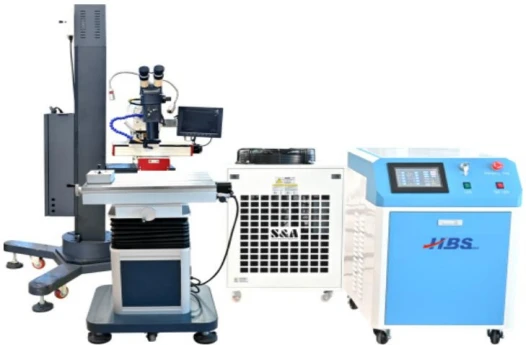
Let's take a closer look at the characteristics of YAG laser welding machines.
First, it's important to clarify that "YAG welding machine" typically refers specifically to equipment that uses a solid-state laser with Nd:YAG crystal as the working medium for welding. Although fiber lasers have replaced YAG lasers in many fields, understanding the characteristics of YAG lasers remains crucial for understanding the development of laser welding technology.
The following are the main characteristics of YAG laser welding machines:
I. Core Advantages
1. **Superior Welding Quality**
* **Small Heat-Affected Zone**: The laser energy is highly concentrated, resulting in a small heating range and minimal thermal damage and deformation to the base material, making it particularly suitable for precision welding.
* **Beautiful and High-Strength Welds**: The weld has a large depth-to-width ratio (i.e., deep and narrow weld), resulting in a beautiful weld shape and high strength, approaching or even reaching the strength of the base material.
* **Cleansing Effect**: Laser welding can remove impurities (such as oxides) from the weld surface, making the weld purer and more corrosion-resistant.
2. **Strong Material Adaptability**
* It can weld not only conventional carbon steel and stainless steel, but also excels at welding **highly reflective materials**, such as **aluminum, copper, and their alloys**. This is a traditional advantage of YAG lasers (especially pulsed mode), as their high peak power can overcome initial high reflectivity.
* It can also weld various refractory metals (such as molybdenum and titanium) and join dissimilar metals.
3. **High Flexibility**
* **Pulsed and Continuous Modes**:
* **Pulsed Mode**: This is the primary application mode of YAG lasers. Suitable for spot welding, thin-plate sealing welding, etc., it allows precise control of the energy and timing of each pulse, enabling precise management of heat input.
* **Continuous Mode**: Suitable for continuous welding of deeper weld seams.
* **Easy to Automate and Integrate**: The laser can be transmitted via fiber optics (later high-power YAG lasers), easily integrated with robots, CNC worktables, etc., to achieve automated welding of complex trajectories.
* **Non-Contact Processing**: No contact with the workpiece is required, there is no mechanical stress, and it can weld precision, small, and hard-to-reach parts.
II. Inherent Disadvantages and Challenges
1. **Low Electro-optic Conversion Efficiency**
* This is the most significant drawback of YAG lasers. Their energy conversion efficiency is typically only **around 3%**, resulting in high power consumption, high operating costs, and the generation of a large amount of heat, placing high demands on the cooling system.
2. **High Operating and Maintenance Costs**
* **Expensive Consumables**: The xenon or krypton lamps used as pump sources are consumables, requiring regular replacement, increasing maintenance costs and downtime.
* **High Cooling Requirements**: Low efficiency means a large amount of electrical energy is converted into heat, necessitating a powerful and stable cooling system.
3. **Relatively Poor Beam Quality**
* Compared to later fiber lasers and disk lasers, YAG lasers have poorer beam quality (BPP value). This limits the miniaturization of the focused spot and the extreme concentration of energy; therefore, at the same average power, their welding speed and penetration depth are generally lower than those of fiber lasers.
4. **Relatively Large Size**
* Due to the need for a flash unit, complex cooling system, and optical resonator, the entire system is typically bulkier than a fiber laser of equivalent power.
III. Main Application Areas
Based on the above characteristics, YAG laser welding machines (especially pulsed types) have occupied, and still maintain, a place in, certain specific areas in the following fields:
* **Electronic Components**: Shielding covers inside mobile phones and digital cameras, precision sensors, micromotors, etc.
* **Battery Manufacturing**: Electrode welding and sealing welding of 18650 and other cylindrical batteries.
* **Medical Devices**: Surgical instruments, pacemakers, endoscopes, and other products requiring extremely high cleanliness and precision.
* **Jewelry**: Fine repair and joining of precious metals such as gold and platinum.
* **Automotive Parts**: Welding of precision components such as fuel injectors, valves, and sensors.
Summary and Current Status
YAG welding machines can be considered "veterans" in the field of precision laser welding.** It ushered in the era of pulsed precision welding, excelling in solving the welding of highly reflective materials and thin plates.
However, with technological advancements, fiber lasers, due to their higher electro-optical efficiency (up to 30% or more), superior beam quality, near-maintenance-free operation (no consumables), smaller size, and longer lifespan, have largely replaced YAG lasers in most medium-to-high power continuous welding applications.
Current Position: Pure YAG welding machines are now uncommon in the new equipment market, but their technical principles and the advantages of pulsed welding have been inherited and developed. YAG welding machines remain in use in some micro-welding fields with specific requirements for pulse characteristics, and on some existing production lines. However, for users purchasing new equipment, fiber laser welding machines are generally the superior choice, unless there are very specific application requirements that necessitate the use of YAG lasers.
https://www.markingmachine2001s.com/mould-repairing-laser-welding-machine
