

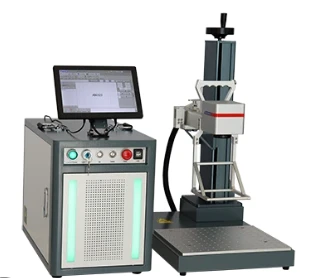
This touches upon the core of laser equipment manufacturers' globalization strategies. The collaboration between laser marking machine suppliers and local overseas technical service centers is crucial to their success in the international market.
This collaboration goes far beyond a simple buyer-seller relationship; it's a deep, mutually beneficial strategic partnership. Below are some mainstream collaboration models and their operational details:
💡 Key Elements of Successful Collaboration
Regardless of the model adopted, the following elements are essential to ensure smooth collaboration and sustained profitability:
1. **Clearly Defined Scope of Responsibilities (SLAs)**
* The agreement must clearly define sales territories, customer ownership, warranty policies, revenue sharing models, and after-sales service response times. This avoids disputes arising from unclear responsibilities.
2. **Systematic Training and Certification**
* **Suppliers** need to establish a comprehensive training system, including:
* **Product Knowledge Training**: The principles and characteristics of new models and functions.
* **Technical Maintenance Training**: How to diagnose and troubleshoot common faults.
* **Application Process Training**: Optimal marking parameters for different materials (e.g., metals, plastics, glass).
* Ideally, establish **technical certification levels** to ensure the service level of partner engineers.
3. **Efficient Supply Chain and Spare Parts Support**
* Suppliers need to establish **global spare parts centers**, or authorize local service centers to manage **small spare parts warehouses**.
* Establish an emergency spare parts channel to provide the fastest possible (e.g., within 48 hours) spare parts support in case of customer downtime emergencies.
4. **Unified Brand and Marketing Image**
* Even with local service, use the supplier's unified logo, uniforms, service processes, and documentation.
* This enhances end customers' perception of the brand's professionalism and trust, making them feel they are receiving original manufacturer-standard service.
5. **Application of Digital Collaboration Tools**
* Use a CRM (Customer Relationship Management) system to share customer information and service records.
* Use an ERP (Enterprise Resource Planning) system to manage orders and spare parts inventory.
* Utilize remote assistance software (such as TeamViewer) for remote diagnostics and guidance, significantly improving efficiency.
🛠️ Collaboration Process and Daily Operations
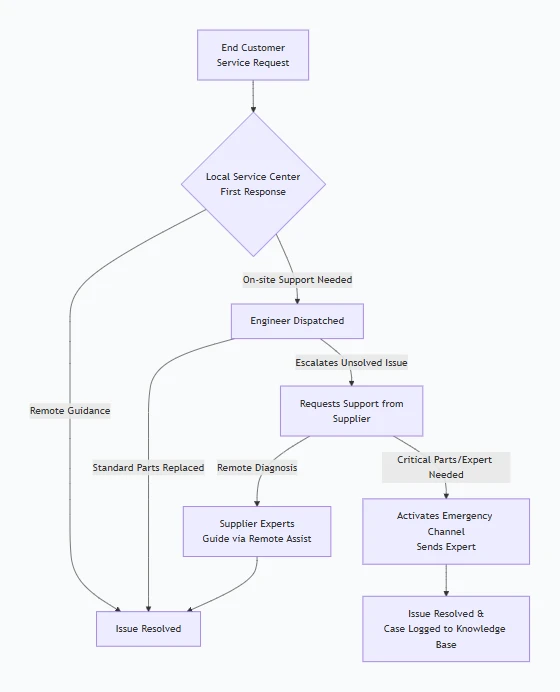
A typical service request handling process is as follows, reflecting the collaboration between both parties:
In summary,
For laser marking machine suppliers, partnering with local overseas technical service centers is essentially about **trading benefits for market share, service efficiency, and customer satisfaction**. Successful collaborations can achieve a win-win situation:
* **Suppliers** can rapidly expand into the global market with a lighter asset model, enhancing their brand influence.
* **Local technical service centers** gain competitive products and profit margins, improving their technical capabilities and market position.
* **End customers** receive timely and professional localized service, eliminating any concerns.
Establishing such partnerships requires careful initial investigation, mid-term agreement refinement, and long-term investment and maintenance, but it is one of the most effective ways to build a competitive advantage in global competition.
https://www.markingmachine2001s.com/fiber-optic-engraving-machine-with
