

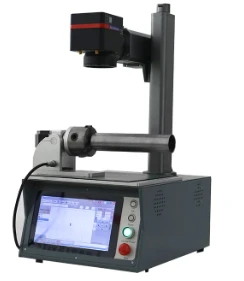
For small gift engraving shops in the US, choosing the right laser marking machine is crucial for business success and profitability. This requires finding the optimal balance between functionality, cost, ease of use, and security.
Generally speaking, **fiber laser marking machines** and **CO2 laser marking/engraving machines** are the most mainstream choices, depending on your primary engraving materials.
Core Choice: Comparison of Two Mainstream Technologies
---
| Features: | Fiber laser marking machine | CO2 laser engraving machine |
| Best Applicable Materials: | Metals, hard plastics, coated materials. | Non-metals: Wood, acrylic, leather, glass, paper, fabric, stone, ceramics. |
| Working Principle: | High energy is generated by a fiber laser, causing physical/chemical changes on the material surface (marking). | Heat is generated by a gas laser, vaporizing or melting the material surface (engraving/cutting). |
| Processing Results: | Fine, permanent, and non-touchable markings. Shallow depth, mostly black and white/gray. Color marking is possible (stainless steel, etc.). | Deep engraving (tactile) and fine cutting are possible. High color contrast (like the scorching effect of wood). |
| Operating costs | extremely low, essentially only electricity. The laser has a long lifespan (100,000 hours). | Regular laser tube replacement is required (ceramic tubes have a lifespan of approximately several thousand hours; RF tubes have a longer lifespan but are more expensive). |
| Price: | Moderate. Entry-level desktop models are competitively priced. | Wide range, from the inexpensive K40 to high-performance models. |
| Safety | requires laser protective shields/goggles, but is typically done in an enclosed work chamber. |
A highly efficient fume extraction system is essential (engraving generates smoke). |
How to Choose Based on Your Business Needs?
Option A: If you primarily engrave **metal products** (stainless steel cups, dog tags, pens, keychains, knives, etc.)
* **Preferred Choice:** A 20W or 30W desktop fiber laser marking machine.
* **Reasons:** This is the gold standard for metal marking. It's fast, provides permanent and clear markings, and requires virtually no consumables. 20W is sufficient for most lettering and simple designs on gift-grade metals. 30W is faster and can handle some darker markings or harder materials.
* **Brand Recommendation:** Focus on brands using **JPT or Raycus laser sources**, such as Haotian and Gweike. These brands typically have agents or warehouses in the US, providing after-sales support.
Option B: If you primarily engrave **non-metallic products** (wooden signs, acrylic keychains, leather bracelets, glass cups, mugs, phone cases, etc.)
* **Preferred Choice:** 40W - 60W CO2 laser engraving/cutting machine.
* **Reasons:** CO2 lasers are the best choice for non-metallic materials such as wood and acrylic, allowing for both deep engraving and precise cutting (for custom puzzles, signs, etc.), greatly expanding your product line.
* **Brand Recommendation:**
* **Entry-Level/Value for Money:** OMTech. Offers a variety of desktop and larger models, high cost-performance ratio, and active community support.
* **Integrated/Ease of Use:** Glowforge. Extremely user-friendly software, fully online operation, suitable for beginners. However, requires a software subscription and depends on internet access.
* **Professional/Reliable:** Boss Laser, Epilog. American brands, reliable quality, good after-sales service, but higher price.
Option C: If you want **multi-purpose functionality**, handling both metals and non-metals (but non-metals are limited to surface marking, not deep engraving and cutting)
* **Optional:** Hybrid or combined use.
* **Hybrid:** Some manufacturers offer "MOPA" fiber lasers, which can produce colored effects on some plastics by adjusting parameters, but cannot replace the deep engraving effect of CO2 on wood.
* **Best Practice:** Many successful gift shops choose a combination of **"one low-power fiber laser + one entry-level CO2 laser".** This keeps the total investment manageable while covering almost all mainstream gift materials.
---
Specific Purchasing Advice for Small American Gift Shops
1. **Identify Core Materials:** List the materials used in 80% of the products you plan to sell. This is the crucial first step.
2. **Software is Crucial:**
* Ensure your machine is compatible with either **LightBurn** or **RDWorks**. **LightBurn** is currently the most powerful and user-friendly software for small laser equipment (one-time purchase, approximately $60), supporting drawing, layout, parameter settings, and has abundant community tutorials.
* **Glowforge** uses its own cloud-based software, which is simple but less flexible.
3. **Safety and Compliance:**
* **Exhaust System:** This is **essential** for CO2 lasers. Choose an exhaust fan and duct with appropriate airflow based on your machine's power. Consider an air-assisted pump to improve cutting results and prevent flames.
* **Laser Safety:** The machine must have a safety interlock device, and the hatch must be closed during operation. In the United States, ensure your equipment complies with **FDA/CDRH** laser product safety standards (reputable brands usually indicate Class 1/Class 4 Laser Product).
* **Fire Prevention:** Especially when carving wood or acrylic, never leave the machine unattended.
4. **After-sales Service and Community:**
* Prioritize suppliers with **warehouses, spare parts, and technical support** in the US. Local support saves significant time and money when the machine malfunctions.
* **Facebook Groups and Reddit's r/lasercutting sections** are valuable resources for learning from experience and troubleshooting.
5. **Budget Considerations:**
* In addition to the machine itself, the budget should include: **exhaust system** ($200-$500), **cooling system** (fiber laser machines may require a small chiller, $100-$300), **safety glasses**, **spare lenses and consumables**, and **material inventory**.
* For start-up shops, a machine costing **$1500 - $4000** is a reasonable entry-level investment.
Recommendation Summary
* **Pure metal/rigid plastic gifts**: Choose a **20W-30W fiber laser marking machine**.
* **Pure non-metallic/desirable cutting:** Choose a 40W-60W CO2 laser engraving machine (such as entry-level models from OMTech or Boss).
* **Pursuing ultimate simplicity, primarily producing small, flat items:** Consider Glowforge, but be aware of its long-term subscription costs.
* **Extensive business, slightly larger budget:** Consider a dual-machine combination of fiber optic and CO2 lasers; this offers the most flexible production configuration.
It is recommended to contact the supplier for samples before making a decision (most reputable suppliers provide these) to test the machine on actual materials. This is the best way to ensure the machine meets your needs. Best wishes for your business success!
https://www.markingmachine2001s.com/mini-portable-laser-marking-machine-hbs-gq-20
