

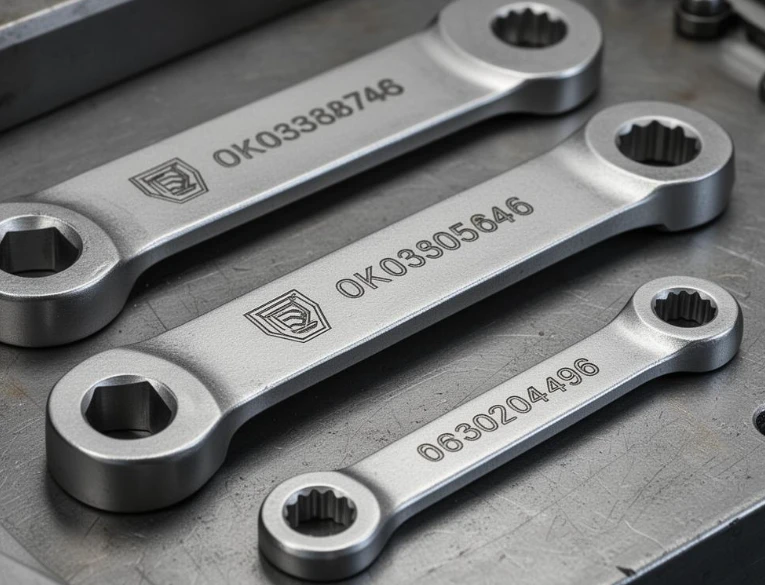
In hardware tool manufacturing, a marking that looks clear on a new product is not always deep enough for the job. Wrenches, sockets, cutting tools and other metal parts may be exposed to friction, handling, oil or repeated use. If the marking is too shallow, product numbers and brand information can become difficult to read over time.
This is why some hardware tool factories look for laser engraving that leaves a more visible, durable mark on the metal surface. Depending on the product, the marking may include a brand logo, size, model number, batch code or serial number.
Why do some metal tools need deeper engraving?
The required marking depth depends on how the tool will be used. A logo on a finished hand tool may only need to be clearly visible, while a code used for identification may need to remain readable after repeated handling. Tools with a coated, hardened or uneven surface can also present different marking challenges.
Laser engraving can create permanent marks without using ink or attaching a separate label. However, the result depends on the metal itself, any surface treatment and the required appearance. A dark surface mark and a physically recessed engraving are not the same thing. Factories should decide which result they need before choosing the machine and setting the process.
Deep engraving is a process adjustment, not just a power setting
When a factory needs a deeper mark, increasing laser power alone may not produce the best result. Marking speed, frequency, pulse settings, focus and the number of passes can all affect the final engraving. The appropriate combination depends on the laser source and the material being processed.
For example, a slower marking speed or several passes may help remove more material, but this can also increase processing time and heat input. If the parameters are pushed too far, the edges may become rough, the marking may lose detail, or the surrounding surface may be affected.
For small text and fine logos, the challenge is to achieve enough depth without making the characters difficult to read. For larger serial numbers or simple symbols, the process may allow a different balance between depth and production speed.
Test the actual tool before choosing the settings
Metal composition and surface finish make a practical difference. Carbon steel, stainless steel and alloy steel do not always respond to laser marking in the same way. A polished surface, an oxidized surface and a coated surface may also produce different results.
For this reason, it is useful to test the laser on the actual tool or a representative sample before confirming the production parameters. During testing, the factory can check the engraving depth, character edges, readability and cycle time. If the tools have already been hardened or coated, these conditions should be included in the test rather than assumed to behave like untreated metal.
A depth measurement can also be helpful when the application has a specific technical requirement. Visual inspection alone cannot reliably confirm how much material has been removed.
Choosing a suitable laser marking machine
Fiber laser marking machines are commonly used for marking metal tools and components. For applications that require deeper engraving, the suitable configuration depends on the material, required depth, marking area and production volume. Higher laser power may help improve processing efficiency in some applications, but it does not guarantee a particular engraving depth or finish.
Factories should compare test results on their own workpieces instead of selecting a machine based on wattage alone. The target depth, acceptable surface appearance and time allowed for each part are all important when deciding on a workable process.
For hardware tool manufacturers, the goal is not simply to make the laser mark as deep as possible. The mark needs to remain clear, meet the product's identification requirements and fit the production cycle. A practical sample test is often the most reliable way to find that balance.
