

On September 17, members of the HBS team visited the CMES Tianjin Machinery Exhibition at the National Convention and Exhibition Center (Tianjin).
As laser processing, robotics and factory automation continue to develop, visiting industry exhibitions is a useful way for us to keep up with new equipment and understand what is changing in the market. This time, we spent several hours walking through the exhibition halls and looking at machines related to metal processing, laser applications, robotics and automation.
One area that caught our attention was laser automation. We saw an integrated laser processing machine with a rotating fixture, designed for cylindrical and tube-shaped workpieces. The combination of the laser head, rotary fixture and control system showed how laser processing can be integrated into a more complete machine rather than being used as a standalone operation.
For HBS, this was particularly relevant to our work with laser marking and automated marking solutions. The way the workpiece is positioned, rotated and processed is an important part of an automated system, especially when customers need to handle batches of similar parts.
 We also looked at equipment used for sheet metal forming and machining. Pressing, turning, chamfering and other processes are often carried out before a part reaches the marking stage. Seeing these machines together at the exhibition also gave us a better picture of the production processes around laser marking and where marking can be introduced into a customer's production line.
Another area we spent time looking at was robotic welding. Several industrial robots were integrated with welding equipment to form flexible workstations. The setup was interesting from an automation perspective, particularly the arrangement of the robot, workpiece fixture and processing equipment.
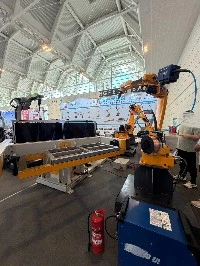
Although welding and marking are different applications, the basic idea of combining a robot with a specific industrial process is similar to what we are working on with automated laser marking. The layout of the workstation, the way parts are positioned and the coordination between different components are all worth looking at when developing an automated marking solution.
For us, visiting an exhibition is not simply about seeing new machines. It is also an opportunity to compare different approaches, talk about current applications and get a closer look at what customers may need next.
The visit gave our team some useful ideas about laser processing, robotic integration and automated production. We will continue to follow these developments and use what we learn to improve our laser marking equipment and automation solutions.
We look forward to bringing more practical and reliable marking solutions to our customers.
